From scan to seat —
one connected workflow.
Every case moves through one system — preferences, QA, routing, and approval, all in the portal. The software does the chasing so the technician can do the craft. Quality is proven, not promised.
Six steps, one screen, zero phone tag.
Follow a case from the doctor’s preferences through milling QA to one-click approval. Every step renders right in the browser — encrypted end to end, with a human on every case.
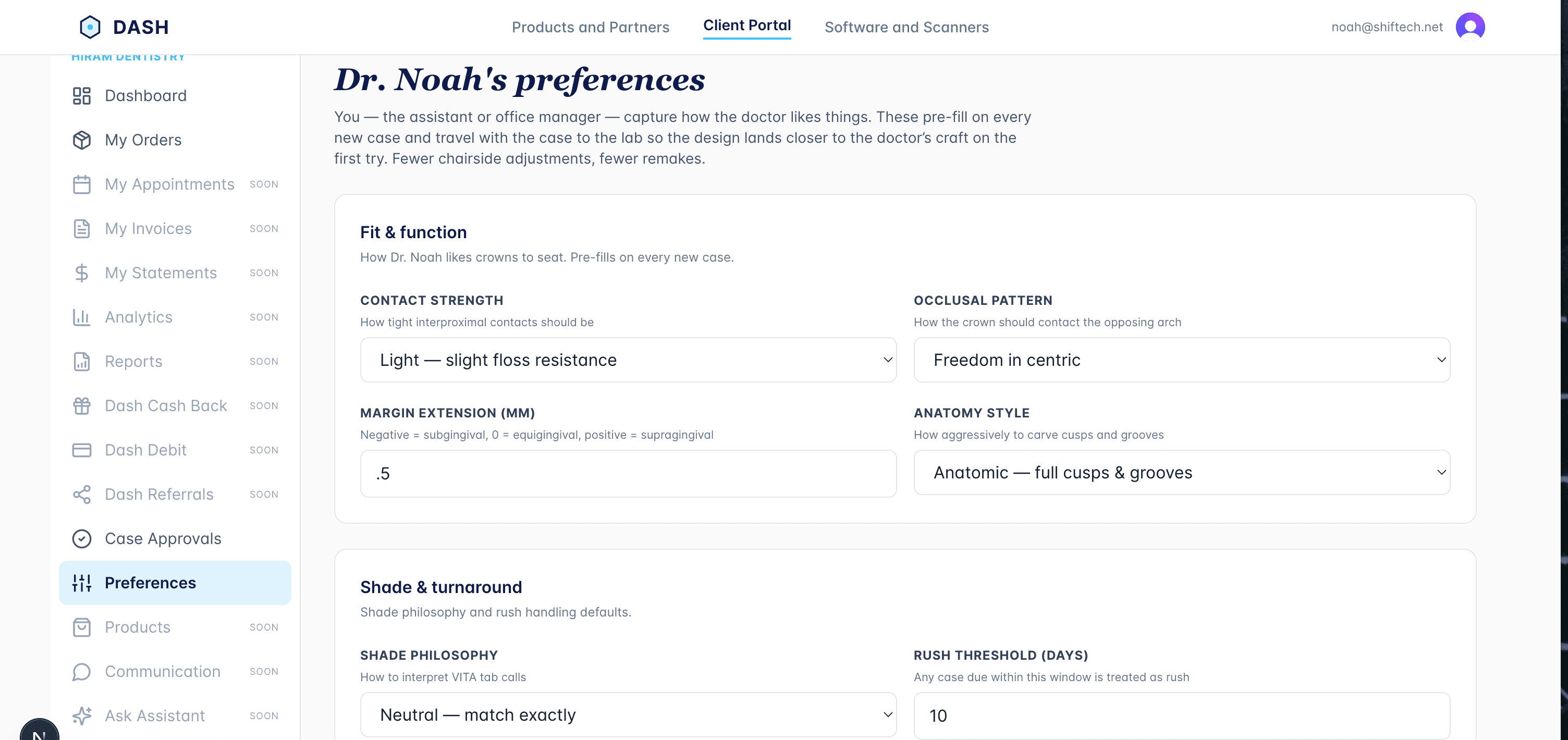
Capture the doctor's preferences once.
Contact style, occlusion, margin design, anatomy, and shade live on the practice profile. Those preferences pre-fill every case — so the design lands on the doctor's craft the first time, not the third.
- Per-doctor defaults applied to every submission
- No re-typing the same instructions case after case
- Designs ship to the doctor's standard out of the gate
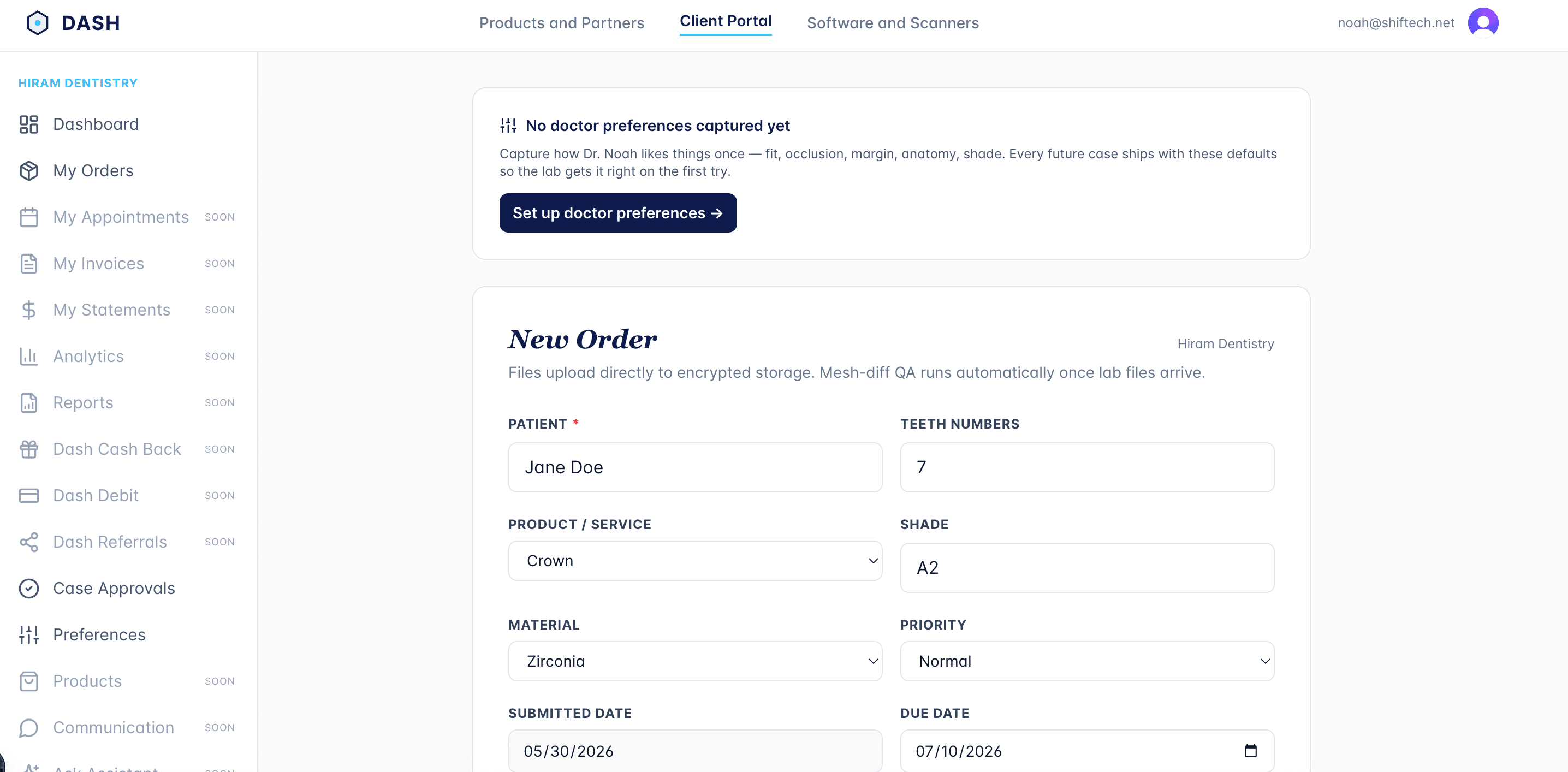
Send the scan from any scanner.
The dentist pushes the STL straight from iTero®, Medit, or 3Shape — or drag-drops an STL, PLY, or OBJ. Files upload to encrypted storage the moment they land. No exports to wrangle, no email attachments.
- Scanner-agnostic — iTero® · Medit · 3Shape
- Drag-drop STL / PLY / OBJ from any workstation
- Files written straight to encrypted storage
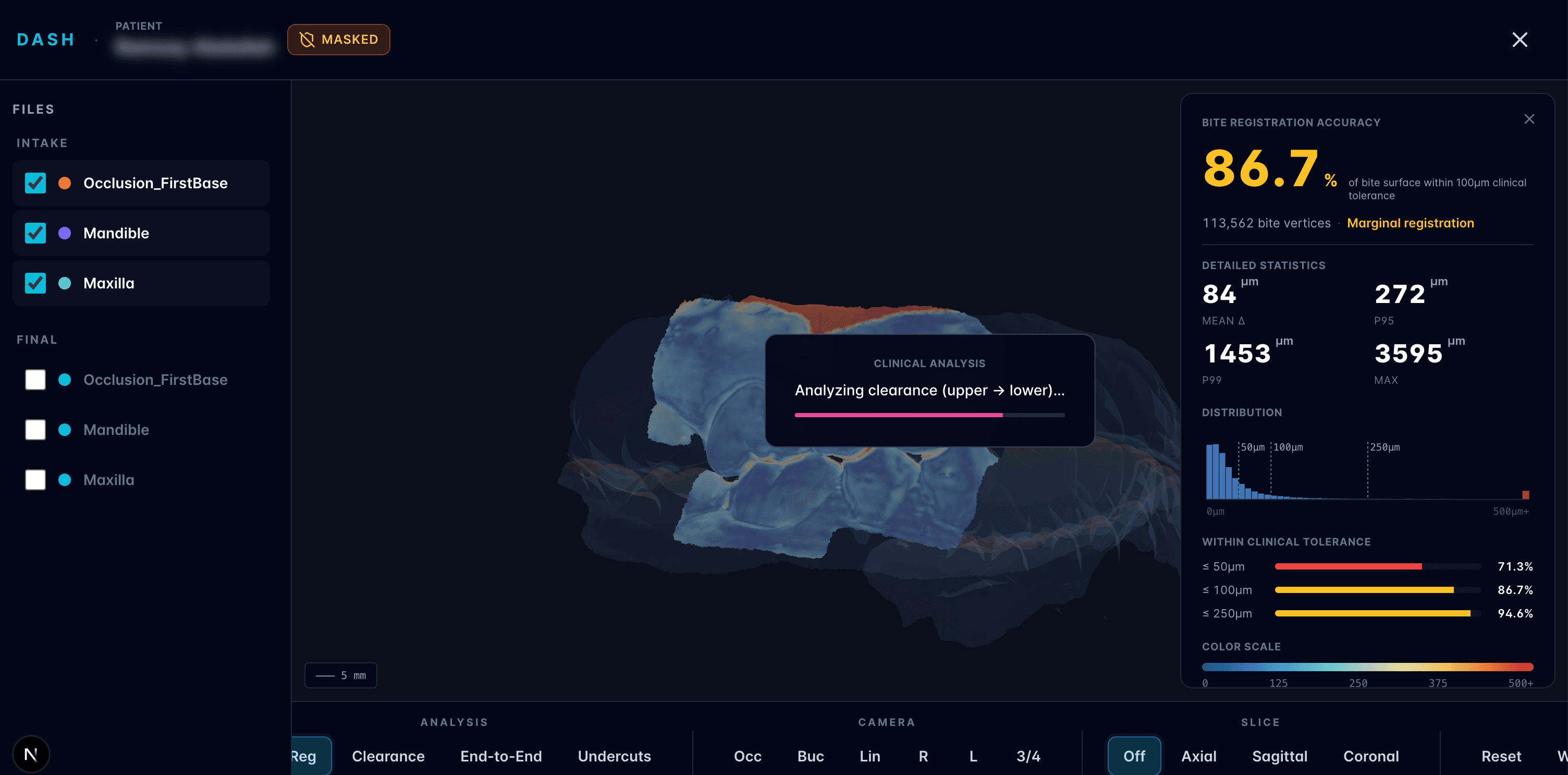
Pre-mill QA the moment it arrives.
Scans render in 3D right in the browser — no plugin, no desktop viewer. Pre-mill QA checks margin definition and occlusal clearance the instant the file lands, so a problem scan goes back before any lab touches it.
- Real-time 3D render in-browser
- Margin & clearance analysis on every scan
- Flagged scans returned pre-mill, not post-seat
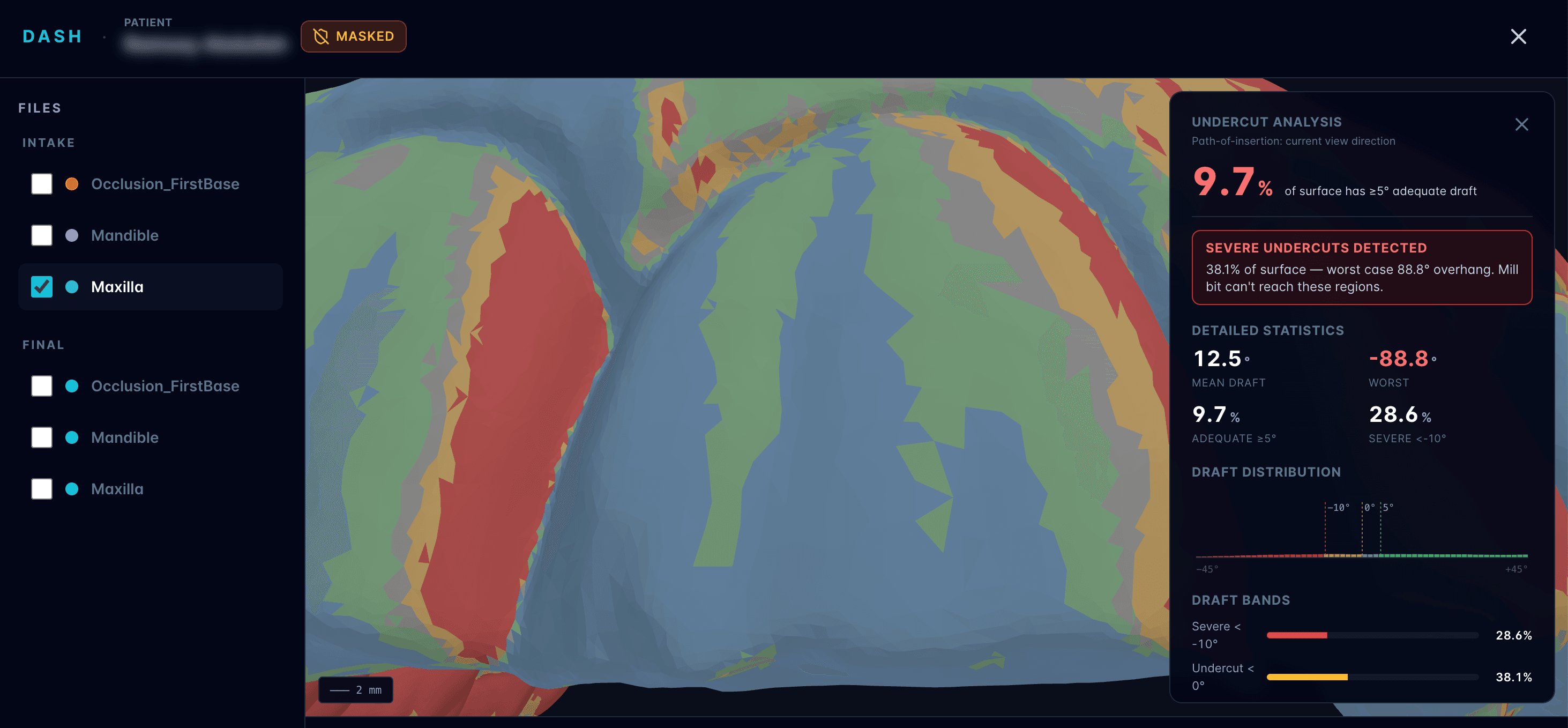
Undercuts caught before milling.
Severe draft violations the mill physically can't reach are flagged on the intake scan — vertex by vertex against clinical tolerance — not discovered at the seat. The doctor sees exactly what we see.
- Undercut & draft detection on the intake mesh
- Findings shown in the same 3D viewer the doctor uses
- Caught at intake, not in the operatory
The right lab — without the patient's name.
Each case is routed to the partner lab best suited to the work. The design is uploaded back through the portal for approval, and PHI is tokenized end to end — partners see the geometry, never the patient's identity.
- Cases matched to the right manufacturing partner
- Design uploaded back for in-portal approval
- PHI tokenized — partners never see patient identity
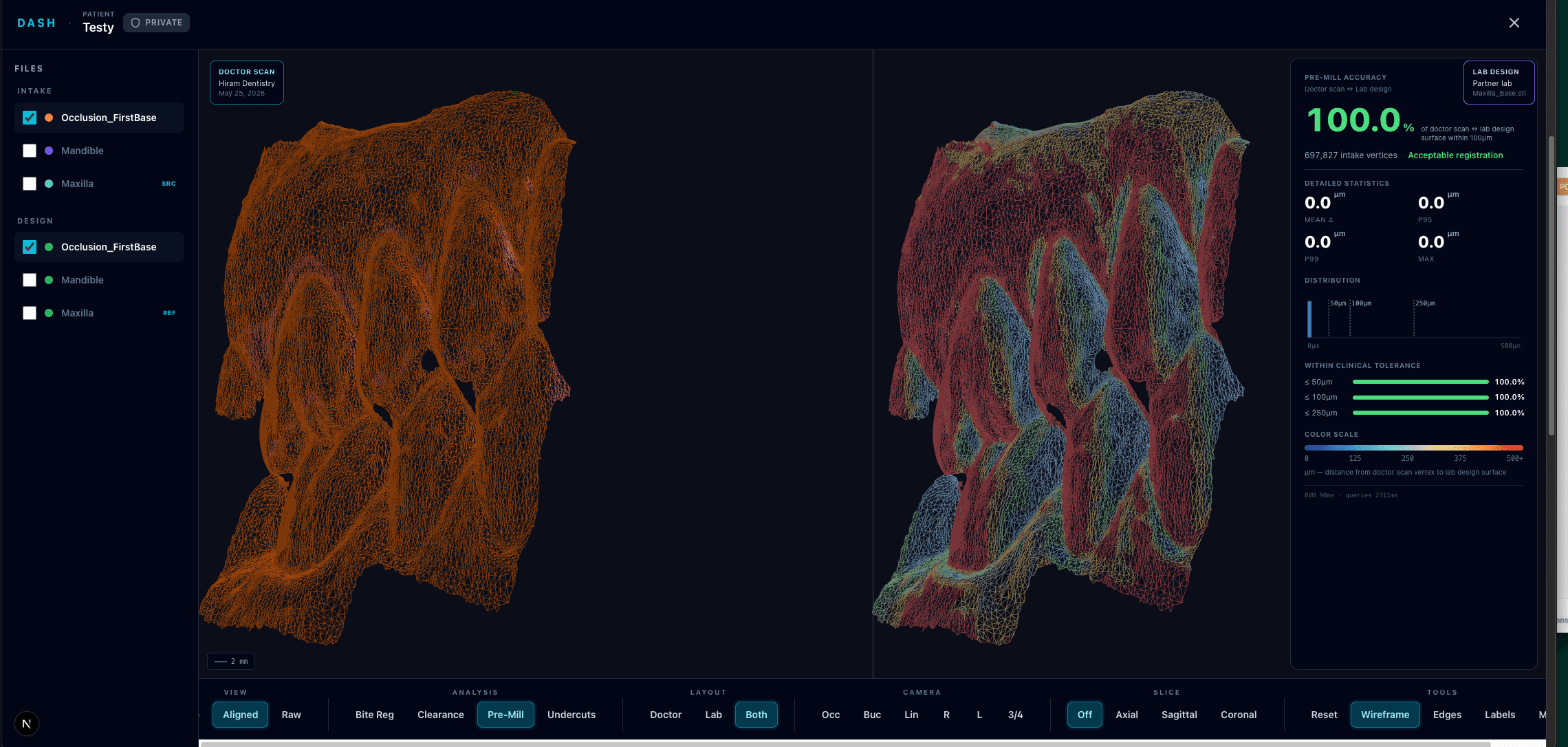
Verified against the approved design.
The milled restoration is 3D-scanned and compared point-by-point against the approved design before it ships. Anything out of tolerance is caught on our bench — not in your chair.
- Milled result mesh-diffed against the design
- 100% within 100µm before a case ships
- Out-of-tolerance work never leaves the bench
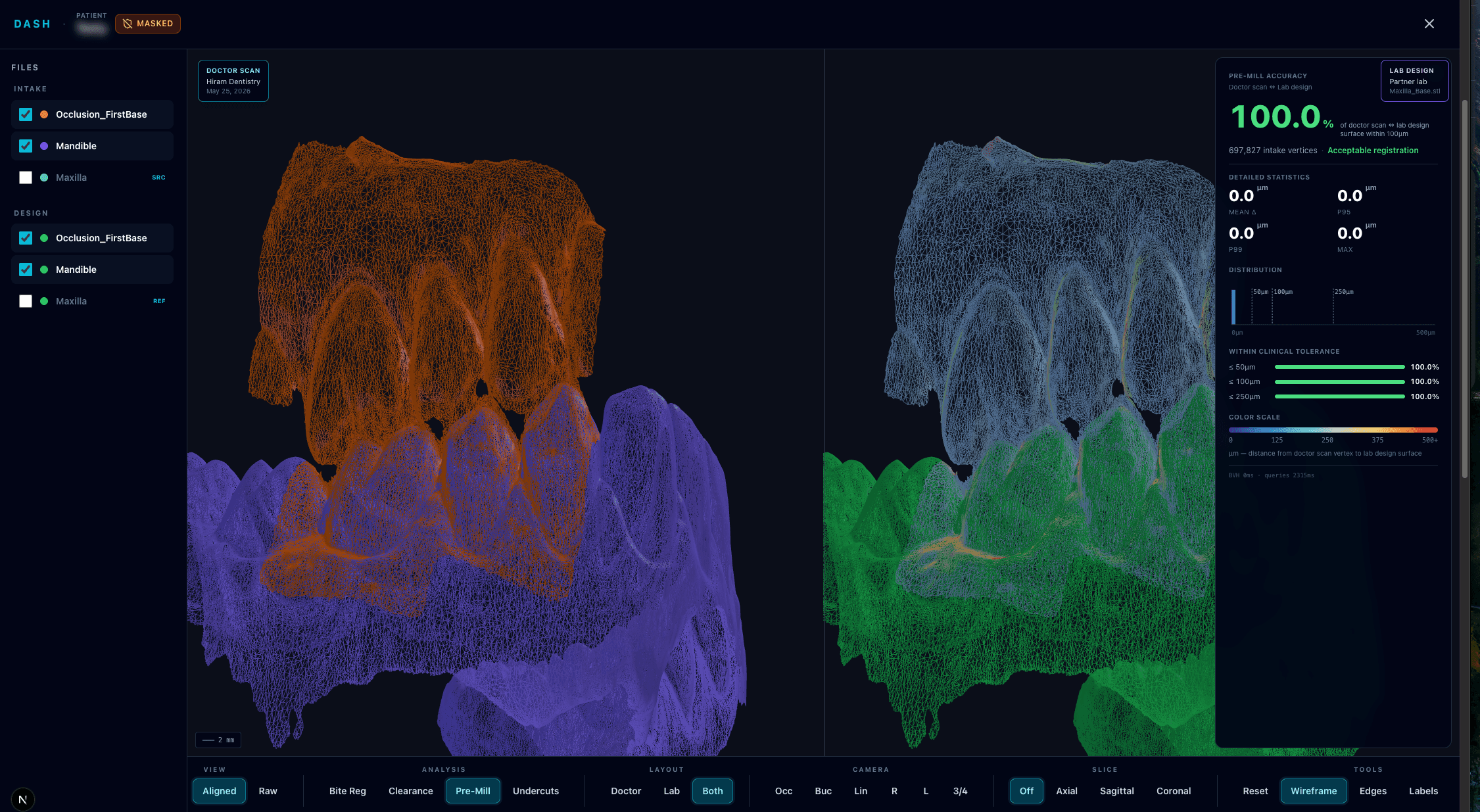
The doctor has the final say.
The case lands back in the doctor’s portal in real 3D, with the QA findings right there. Review, then approve or request a change — one click, no phone tag, tracked all the way to the door.
Encrypted end to endPHI tokenized to partner labsHIPAA-grade infrastructureAppend-only audit log
One hub. A world-class supply chain.
Signals route from US dental clinics nationwide into Dash’s Atlanta hub, then out to the manufacturing partners and material suppliers best suited to each case. We don’t buy what’s in the drawer — we pick the right maker, anywhere in the world.
Precision CNC milling partner
Drufosoft® splint material — Dreve
Z-CAD® zirconia — Metoxit AG
Leaf Expander — Leone S.p.A.
KATANA™ zirconia — Kuraray Noritake
Manufacturing partner
Manufacturing partner
Dash hub — routing, QA & shipping
Schedule a call with our clinical team.
A 15-minute call with a Dash lab tech — we’ll walk you through the portal, match your preferences, and set up your first case on us. No commitment.
KATANA™ (Kuraray Noritake), Z-CAD® / Metoxit (Metoxit AG, Switzerland), Drufosoft® (Dreve, Germany), Leaf Expander (Leone S.p.A., Italy), iTero® (Align), Medit, and 3Shape are referenced for descriptive purposes only. Brand names are trademarks of their respective owners.